
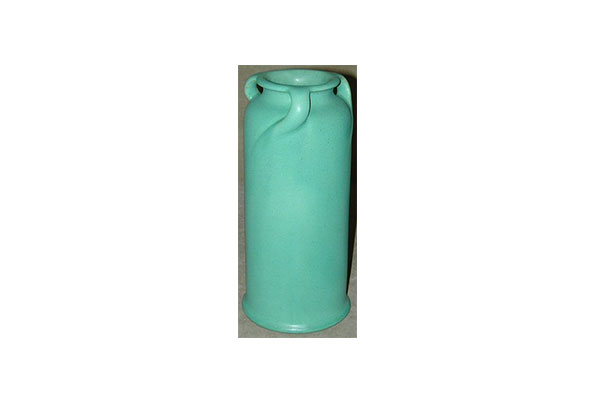
William D. Gates founded American Terra Cotta & Ceramics Company in 1887 in the Crystal Lake  area which is northwest of Chicago. Gates initially got into the terra cotta business in 1880s when he founded Spring Valley Tile Works which was subsequently renamed Terra Cotta Tile Works. Gates’ entry into the Terra Cotta business put him in direct competition with Northwestern Terra Cotta Company.
Decorative art pottery became a logical expansion from the terra cotta business for Gates. The rapid growth of arts and crafts pottery led William Gates to form a new subsidiary called Gates Pottery in 1899. The art pottery produced by Gates Potteries would be called Teco ware.
William Gates came up with the Teco name from the “Te” in Terra and the “co” in Cotta. Soon thereafter Gates and his chemists developed the highly sought after “Teco matte green” for which the company is famous. After mastering the matte green color, Gates continued to experiment with new arts and crafts shapes for his vases.
It was always Gates’ desire with Teco to produce pottery with appeal from shape and color rather than elaborate decoration. The expanding arts and crafts movement and the Prairie School provided Gates an approach to architectural ceramic design and a customer base for Teco pottery. Teco, possibly more so than any other arts and crafts pottery from its time, seems particularly at home in arts and crafts bungalows and houses designed by Frank Lloyd Wright and other Prairie style architects.
By 1930 William Gates sold American Terra Cotta & Ceramics Company to the family of George A.  Berry, Jr. At some point the company was renamed American Terra Cotta Corporation. The pottery resumed making garden pottery as well as architectural terra cotta. A company brochure from 1937 showed a small selection of garden pottery including vases in blue, yellow, brown, white and matte green. During the 1930s, the company began referring to itself as Teco Potteries. Workers at the Teco potteries reported that garden pottery was produced until 1941.
Reference: Teco – Art Pottery of the Prairie School by Sharon S. Darling

Downtown Crystal Lake and Crystal Lake Central High School showcase some architectural terra cotta that probably was produced by Teco.
Downtown Crystal Lake and Crystal Lake Central High School showcase some architectural terra cotta that probably was produced by Teco.