Art Pottery Blog

  • Home
  • Archives
  • Sitemap
  • Just Art Pottery
  • American Art Pottery
    • Carolina Pottery
    • Frankoma Pottery
    • Fulper Pottery
    • George Ohr Pottery
    • Grueby Pottery
    • McCoy Pottery
    • Newcomb College Pottery
    • North Dakota Pottery
    • Rookwood Pottery
    • Roseville Pottery
    • Scandinavian Pottery
    • Teco Pottery
    • Van Briggle Pottery
    • Weller Pottery
  • Art Pottery News and Events
    • Art Pottery Shows and Events
    • Arts and Crafts Events
    • Auctions.JustArtPottery.com
  • Buying, Selling and Collecting Art Pottery
    • Buying Art Pottery
    • Care and Cleaning of Art Pottery
    • Selling Art Pottery
  • Miscellaneous
    • Arts and Crafts Accessories
    • Off Topic
    • Useful Sites
  • Modern Art Pottery
    • Contemporary Art Pottery
    • Contemporary Ceramics
    • Ephraim Faience Pottery

Cowan Pottery

January 18, 2012 by Donna McGill · Leave a Comment

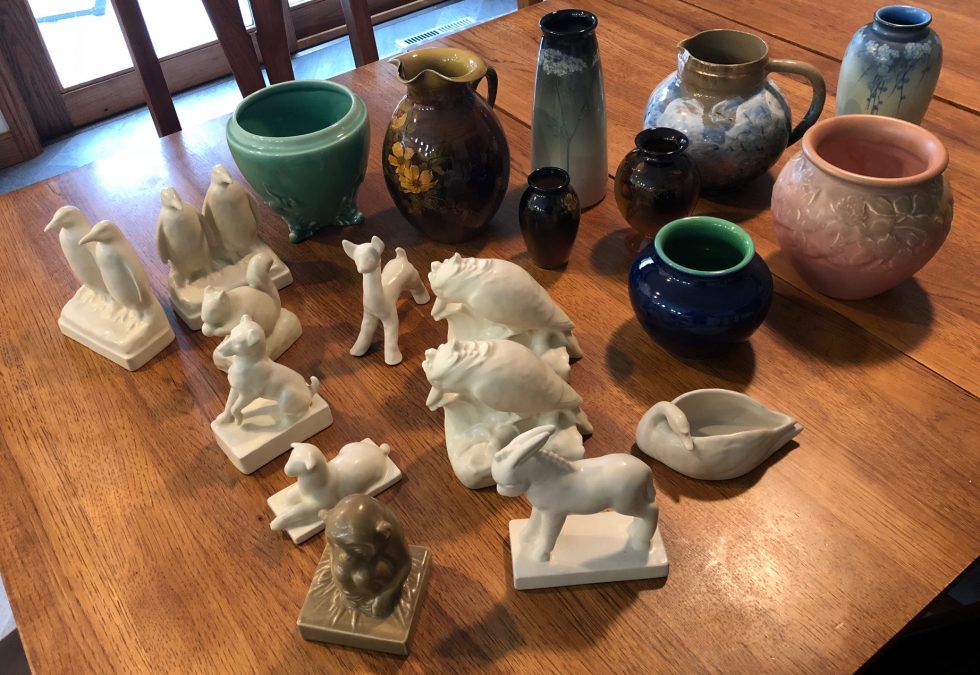
Cowan Pottery was in business for a brief period of time; specifically, between 1912 and 1931. That’s not to say, however, that this Ohio art pottery company didn’t leave a lasting impression – it most certainly did.

Founded by R. Guy Cowan, an Ohio native, Cowan Pottery began as a tiny studio with only a few kilns and with Cowan serving as the owner, artist, designer, bookkeeper and so on. Despite what was surely an exhausting effort, Cowan produced many art pottery pieces and tile designs. By 1917, Cowan was enjoying the fruits of his hard work with many awards for his art pottery collections.

As was the case with many art pottery companies during this time period, World War I meant a closing of his business so that he could serve in the Chemical Warfare Service. The war ended and Cowan found himself following his passions once again, this time in a new location in Ohio. He upped the equipment, created a studio and before long, he was filling orders for department stores, individuals and other national chains. That was soon followed with commercial pottery efforts. He was able to hire a staff of artists and his output neared 175,000 pieces each year. Some of those Cowan Pottery pieces included bowls, vases, lamps and candlesticks.

Despite his impressive successes, in the late 1920s, Cowan found his business struggling financially. The demand was slowly dropping for pottery, as would-be customers found themselves struggling from a financial aspect, too. Indeed, times were incredibly difficult and by 1930, the writing was on the proverbial wall. The Depression hit fast and hard and Cowan Pottery closed its doors in December, 1931.

The legacy left behind is priceless. The glazes and artistic abilities are nothing short of genius; partly due to Cowan’s familiarity with the chemicals used in the American art pottery sector.

Cowan knew he could never walk away from art pottery and became a well respected judge and trustee for the National Ceramic Exhibitions until his death in 1957.

StumbleUponShare

Just Art Pottery Bargain Bin

January 11, 2012 by Donna McGill · Leave a Comment

Have you checked out the great finds in our Bargain Bin? This is a great opportunity to add to your art pottery collection or if you’re new to this particular art sector, it’s the best place to start. Check out a few of the latest additions to the bin -

Drawn to the more whimsical side of American art pottery? Then the Abingdon Pottery cookie jar is probably just what you’re looking for. This sweet Miss Muffet, who’s resting on her tuffet, dates back to 1949-1950 and is mint condition. The bottom is marked and this cookie jar measures 9 1/2″ tall and 8 1/4″ wide.

The Coors Pottery blue handled vase is a perfect example of how less is sometimes more in art pottery. The blue glaze on this double-handled vase contrasts nicely against the white glaze on the inside of the vase. It’s in excellent condition and measures 6 1/2″ tall and 7 1/4″ wide.

The unique presentation is what sets this Haegar Pottery Marigold Agate Earth Wrap Vase apart. The rich sunflower gold and yellow hues are a powerful base against the contrasting red and brown that present as abstract designs. It’s modern look and one many collectors are drawn to.

Hull Pottery remains one of the most recognized names in the industry. The Hull Pottery bow knot blue wall pocket is just one reason why. This design has a beveled handle, two side pockets and pink flowers with soft green leafing efforts. It’s a little vintage, a little traditional Hull and a lot of style. This is one that can be difficult to locate, so if you’re contemplating adding this to your Hull Pottery collection, now’s the time.

Speaking of vintage, there’s also a Rorstrand 1960s Swedish Titus art deco vase. This vivid vase offers a glossy finish against a rich blue and hues of brown. The lighter base color works well with both the colors and general design. It’s handpainted and is 6 1/4″ tall and at its widest point, measures 6″ wide.

These are just a few of the many gems you’ll find in the Just Art Pottery bargain bin.


StumbleUponShare

Avoid Buying Fake Roseville Pottery

January 1, 2012 by Donna McGill · Leave a Comment

One major reason people avoid collecting American art pottery is because they fear not being able to differentiate between fakes and true Roseville Pottery.

The truth is, some of the fake Roseville pieces have a sense of authenticity that makes it difficult to tell apart from true Roseville Pottery. Aside from getting your collection appraised (which we always strongly encourage), you may never know for sure. Then again, there are those who see the beauty and would still purchase it, even if it were a fake, so that

Collection of Roseville Baneda

they could display it in their home. There’s nothing wrong with that, of course, except you probably paid Roseville Pottery prices for fake Roseville pieces.

For those who find it difficult to tell apart, there are a few tell-tale signs that might clue you in. Keep in mind – this is all very subjective in that what one’s idea of a “dull glaze” might be different than another’s – again, this only reiterates the importance of a professional appraisal.

Take a look at the glaze on your piece; fakes lack a certain depth and without a “clear” look; it can even look dull and flat. Also, the glaze shouldn’t hinder the nuances of clay underneath it.

Take a look at the handles (if applicable). Fake pieces usually have bigger handles in terms of their dimensions. Again, this is subjective, but for those familiar with this line of art pottery, the differences are obvious.

How about the detailing? Authentic Roseville Pottery offers a lot of detail – the vines, florals, etc. The Roseville artists always took pride in their detailing efforts.

There were many Roseville marks through the years; so many that sometimes even collectors question a Roseville marking. There are those with Roseville U.S.A. or wafer marks or ink stamps – the marking often dates your Roseville piece; however, fraudsters will do their best to replicate the markings in order to fool buyers.

So what should you do to keep from being taken? We always tell customers to study their Roseville pieces they know are authentic. Usually, once you know what truly is real, the fakes become easier to identify. It’s also a great way to learn more about the history of this dynamic line of American art pottery.

If you’re looking to have your Roseville Pottery collection (or any other collection) appraised, give us a call. All of our appraisals are done in accordance with the Uniform Standards of Professional Appraisal Practice (USPA). Greg Myroth is a member of the Association of Online Appraisers and abides by the AOA Code of Ethics. For more information, visit our Just Art Pottery appraisal page.

StumbleUponShare

The Talent Behind the Grueby Pottery Name

December 18, 2011 by Donna McGill · Leave a Comment

Most American art pottery companies, especially at the turn of the century and then again during the Great Depression were all too familiar with cultivating talent, only to lose that talent to the competition or because the talent was needed elsewhere – even if that “elsewhere” had little to do with the art pottery sector.

This week, we take a look at some of the best talent that at one time or another called Grueby Pottery their employer. We start with none other than William Henry Grueby.

Grueby hadn’t shown much of an infinity for tiles or other art pottery in his youth; instead, he had to find a job – any job – when he left school in 1882. That job would be a CA Wellington an Co., which specialized in decorative arts. Eight years later in 1890, Grueby and a friend he met while working at CA Wellington left to form their own company. That friend, of course, was Eugene Atwood and the company was aptly named Atwood and Grueby.

Eugene Atwood

Atwood remained with Atwood and Grueby until 1894. It was then he decided to strike out on his own. His company produced architectural faience and enameled bricks. Six years later, Atwood Faience found itself in reorganization and eventually new management took over. When that happened, it was renamed Hartford Faience.

There was also a third partner, though his name was never on the letterhead. William Hagerman Graves had graduated college more than a few times and continued to rack up degrees when he was approached to serve as treasure to Atwood & Grueby. As far as most historians believe, Graves had created a single piece of Grueby Art Pottery – a blue bowl that was inspired by Japanese influences. Eventually, he left the company and went to work for a tile company.

Karl Langenbeck

Langenbeck was a brilliant man who had received significant training in chemistry, which he put to use when he was approached in 1908 by Grueby Faience to work out “technical problems”. Langenbeck is one of those talents mentioned above – those who come and go. He’d already worked for Rookwood Pottery of Cincinnati in the role of a glaze expert in the late 1800s.

Finally, we take a look at one of those creative minds behind the Grueby name. Ruth Erickson created a beautiful fern handled vase. So unique was it that it was exhibited at the Newark Museum and then a year later, in 1911, the museum purchased it to have on permanent display. Erickson also was the talent behind several of the Grueby tobacco jars. If you have any, you might notice a marking of 1/21/01 – one not familiar with art pottery might wrongly assume the marking is indicative of 2001, which, of course, is not so. Most of those tobacco jars were made in 1901.

The talent and business minds who defined this art pottery company were many. Some were around for the long haul, while others made contributions and then moved on. Regardless, what we’re left with today is a versatile and beautiful line of American art pottery.

StumbleUponShare

Rookwood Pottery’s Mississippi Connection

December 12, 2011 by Donna McGill · Leave a Comment

Rookwood Pottery is truly one of those American classics – not only in terms of art pottery, but in its totality as a business model. It survived the Great Depression when companies around the nation were folding. It’s undergone many changes in ownership, barely missed being sold to international buyers and through it all, the talent that is Rookwood Pottery continued to turn out some of those most beautiful collections the art pottery community has ever known.  What many people don’t know is that Rookwood Pottery temporarily relocated to Starkville, Mississippi in 1959. The ownership had just changed hands once again and even though the company had survived those difficult years in the 1930s, it struggled for many years after the Depression. The move to Mississippi was designed to put the company back at the top of its game. Unfortunately, it was unable to do so and as a result, folded (albeit temporarily) in 1967. At the time, no one knew for sure whether this American pottery company would be able to make a successful comeback.

Rookwood Pottery now calls Cincinnati home. It was purchased in the early 1980s by an in Ohio physician. Upon learning that Rookwood might be relocating to another country, Dr. Arthur Townley made his decision. He moved fast and indeed, invested all of his savings, in a bid to keep the company here in the U.S. This was in 1982. More recently, Rookwood Pottery was moved yet again to the Cincinnati area – on Race Street to be specific -and in 2006, Dr. Townley agreed to sell his assets, which included trademarks and even glaze recipes. This was surely a difficult decision for the dentist, but for the same reasons he purchased the company all those years ago, he believed it was the right thing to do.

Regardless of what ultimately happens with this company, there is no denying the indelible mark it left on the art pottery world as a whole and our society. Rookwood Pottery continues to increase in both its value and the number of those who are just beginning to see what many have known for decades.

StumbleUponShare

Newsletter

Newsletter
Subscribe for FREE!

to get updates on sales, new inventory,
and art pottery news

Email Alerts

Enter your email address to receive new posts in your inbox:

Shop for Art Pottery


Bid In Our Online Pottery Auctions

RssArtPotteryBlog.com RSS

Recent Posts

  • Cowan Pottery
  • Just Art Pottery Bargain Bin
  • Avoid Buying Fake Roseville Pottery

Archives

Recent Comments

  • Roseville Pottery – Damage and Restorative Efforts (3)
    • Bob: Nine times out of ten I’d pass on piece that has a defect, unless it’s a rare and unusual piece or I...
    • Victoria: Sometimes I think defects in pots can make them more desirable and unusual. Damage is just something that...
    • Matt Astleford: Thanks for the essay. I operate a small antiques and collectibles restoration studio...
  • Weller Pottery Reference Books (5)
    • Kelly Gray: Did Weller make covered casserole dishes set in silver trays with black wood handles. I have collected...
  • Brush – McCoy Cookie Jars (4)
    • Becky Wise: I’m looking for the deminsions for the Cinderella Pumpkin cookie jar. The book I have doesn’t...
  • New Additions
  • Sale Items
  • Search Our Inventory
  • Bid In Our Online Auctions

Roseville Pottery

  • All Roseville Pottery
  • Roseville Patterns A-E
  • Roseville Patterns F-L
  • Roseville Patterns M-R
  • Roseville Patterns S-Z
  • Roseville by Shape

American Art Pottery

  • Fulper Pottery
  • Grueby Pottery
  • McCoy Pottery
  • Newcomb College Pottery
  • Rookwood Pottery
  • Teco Pottery
  • Van Briggle Pottery
  • Weller Pottery
  • + More American Art Pottery…

Modern Art Pottery

  • Door Pottery
  • Ephraim Faience
  • Jemerick Pottery
  • Teco Art Pottery Collection™
  • + More Modern Art Pottery…
  • Bargain Bin
  • European Ceramics
  • Arts and Crafts Accessories
  • Art Pottery Bookstore

Art Pottery Links

  • ArtPotteryBlog.com
  • ArtPotteryPlace.com
  • Auctions.JustArtPottery.com
  • JustArtPottery.com

Auctions.JustArtPottery.com

  • How to Buy
  • How to Sell
  • Why Sell Art Pottery with Us

Follow Just Art Pottery on

and Roseville Pottery
facebook

twitter facebook

Return to top of page

Copyright © 2012 · Art Pottery Blog